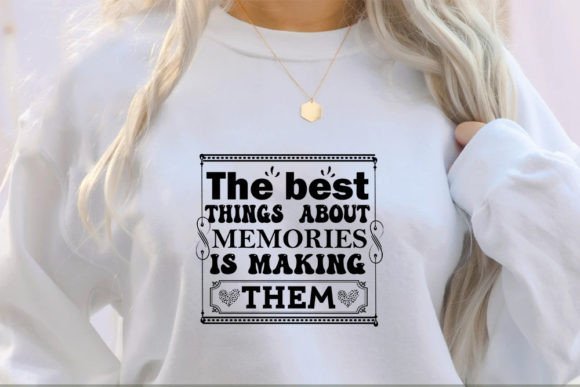
The Best Things About Memories is Making
As someone who’s stitched thousands of designs across baby onesies, boutique tote bags, and custom sweatshirts, I opened The Best Things About Memories is Making expecting warmth—and got it instantly. This isn’t a loud, trend-chasing graphic. It’s quiet, intentional, and emotionally grounded—the kind of design that makes a customer pause mid-scroll on Etsy or linger at your craft fair table. I tested it as the centerpiece for a linen tea towel series, then scaled it for a set of embroidered baby blankets. Here’s what held up—and where you’ll want to lean in with care.
A Design That Breathes With Your Fabric
First impression? Soft rhythm. The phrase flows left to right like handwriting, but with gentle structure—no sharp angles, no cramped kerning. The letterforms have subtle weight variation, giving them dimension without demanding dense fill stitches. There’s no heavy shadow, no outline border, no clipart stiffness. That’s huge. In real embroidery, simplicity like this translates to clean satin-stitch curves and forgiving running-stitch transitions—especially important when stitching on textured fabrics like terry cloth or slubbed linen.
I used it on a medium-weight cotton twill tote bag first. With light tear-away stabilizer and 40-weight rayon thread, the text stayed legible even at 3.5 inches wide. No thread nesting in the “s” curves. No skipped stitches in the thin crossbars of the “t”s. That tells me the vector paths are well-constructed—not just traced from a raster image. The EPS and SVG files gave me full control to resize without pixelation; the DXF handled cleanly in my embroidery digitizing software when I needed to tweak stitch direction for curved surfaces.
Where It Shines (and Where It Asks for Partnership)
The Best Things About Memories is Making thrives in thoughtful, human-scale applications: personalized baby embroidery on onesies or burp cloths, minimalist sweatshirt fronts for small shops, nursery wall hangings, or stitched-on patches for denim jackets. Its gentle cadence supports emotional storytelling—perfect for handmade products meant to be gifted, kept, or passed down.
It works beautifully on stable, low-stretch fabrics: cotton poplin, quilting cotton, canvas, and medium-knit fleece. On those, standard cutaway or medium-weight tear-away stabilizer is all you need. But here’s the honest note: avoid using it full-size on highly stretchy jersey or ultra-thin voile without significant digitizing adjustments. The lowercase “a” and “e” have enclosed counters that can collapse if stitch density isn’t balanced for fabric movement. And while the PNG preview looks crisp on screen, remember—it’s a graphic, not an embroidery file by default. You’ll need to digitize it properly for machine embroidery use, especially if adding applique elements or decorative accents.
For caps or curved surfaces, scale it down to 2.75 inches max and adjust underlay stitches manually. The original layout assumes a flat plane—so don’t assume it will auto-fit a crown curve without testing. Same goes for dark fabric: test contrast early. The design relies on shape and spacing more than bold outlines, so pale thread on black fabric may read softly unless you boost stitch density slightly or add a subtle satin-stitch border.
What It Adds to Your Finished Product—Beyond Aesthetics
This isn’t just about legibility. The Best Things About Memories is Making elevates perceived value. Because it doesn’t shout, it invites attention. Customers notice the care in the spacing, the intention behind the curve of the “g”, the way the final “g” echoes the first “M”. That subtlety reads as handmade professionalism—not mass-produced clipart. For Etsy sellers and small shop owners, that nuance builds trust. It says, “I chose this because it fits *your* story—not because it was trending last month.”
In holiday embroidery or wedding gift contexts, it avoids cliché. No hearts, no doves, no scripted “forever”—just quiet resonance. I paired it with simple leaf motifs on kitchen towels for a bridal shower set, and buyers specifically mentioned how “calm” and “timeless” it felt compared to busier alternatives. That’s brand consistency in action: soft, sincere, and scalable across product lines.
Practical Designer Notes Before You Stitch
- Always test on scrap fabric first—especially if stitching on textured or dark materials. Check how the “r” and “n” legs land next to each other; slight crowding can happen at smaller sizes.
- Review stitch density before finalizing. Lighter fills work better on breathable fabrics like tea towels; denser satin stitches hold up better on high-wash items like baby clothes.
- Confirm hoop size compatibility. At full recommended width (3.5–4 inches), it fits standard 5x7 hoops—but verify your machine’s maximum stitch area before loading.
- Inspect small details in your embroidery software: the dot over the “i”, the tail of the “y”, and the inner space of the “o” should all clear cleanly at your target size.
- Test black-and-white mockups to gauge contrast on both light and dark backgrounds. What reads softly on white may vanish on navy without minor tweaks.
- Use proper stabilizer—not just for support, but to prevent puckering that distorts the gentle flow of the phrase.
- Check licensing terms before selling finished embroidered items or digital embroidery files. The product listing states these are ready-to-use graphics—but commercial embroidery rights require confirmation from the seller.
A Design That Fits Real Life—Not Just the Screen
At its core, The Best Things About Memories is Making succeeds because it understands context. It doesn’t try to be everything. It’s not a logo, not a mascot, not a slogan meant for banners or storefront signage. It’s a whisper in thread—meant for the inside pocket of a handmade apron, the corner of a baby quilt, the chest of a relaxed-fit sweatshirt sold at a local market.
If you’re an embroidery designer building a library of T-Shirt Designs or Graphics for resale, this is a keeper—not for volume, but for versatility. Pair it with neutral palettes, natural fibers, and thoughtful packaging, and it becomes more than decoration. It becomes part of the memory itself.