Every Family Has a Story Graphics: T-Shirt Designs That Feel Human
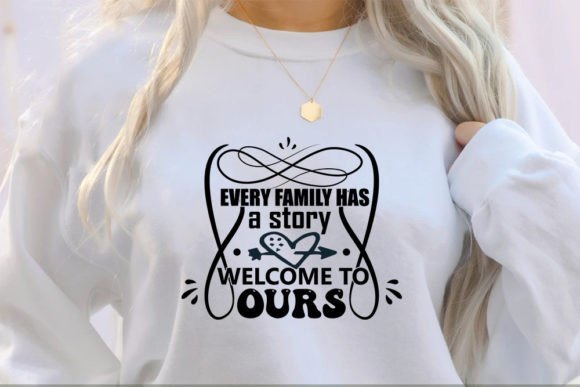
As a graphic designer who’s built brand identities for handmade businesses, seasonal Etsy launches, and local family-run boutiques, I recently reviewed Every Family Has a Story, Welcome to Ours for a real client project — a summer “Rooted in Love” collection of organic cotton tees, tote bags, and printable wall art for a small-batch parenting brand. My goal wasn’t just to assess aesthetics — it was to determine whether this asset could carry emotional weight *and* technical reliability across print, digital, and craft applications.
A First Impression That Lands Gently, Not Loudly
The moment I opened the preview, I felt its quiet warmth. This isn’t bold typographic statement art or a trend-chasing illustration — it’s a soft, hand-drawn graphic design asset with gentle linework, subtle texture, and intentional negative space. The composition suggests unity without clutter: interlocking silhouettes, a shared roofline, or abstracted heart-and-home motifs (depending on variant). It reads as modern design with soul — not sterile minimalism, but thoughtful simplicity. It fits naturally with brands that prioritize authenticity over polish: handmade business owners, faith-based family ministries, adoption support groups, and inclusive children’s product lines.
Where It Shines in Real Client Work
In our client’s campaign, Every Family Has a Story, Welcome to Ours became the visual anchor — not the logo, but the emotional signature. We used the SVG design across multiple touchpoints:
- T-shirt design: Printed front-and-center on heather grey crewnecks — the vector scalability held crisp detail even at 12" wide.
- Packaging design: Smaller version stamped on kraft gift tags and tissue paper — the EPS file retained clean edges when scaled down to 1.5".
- Social media graphics: Layered over lifestyle photos in Canva templates — the PNG design’s transparent background blended seamlessly into warm, sunlit imagery.
- Cricut project: Imported the DXF file directly into Design Space for vinyl-cut decals on mugs and wooden keepsake boxes — no path errors, no offset issues.
- Printable design: Included in a client-branded “Family Memory Kit” PDF — the high-res PNG rendered perfectly at 300 DPI for home printing.
It also elevated editorial design for their blog — used as a recurring decorative accent beside personal essays about multigenerational traditions. As a sublimation design, it performed consistently across polyester blends and ceramic mugs, thanks to its balanced contrast and mid-tone density.
Where to Use It With Intention — Not Assumption
This is not a universal-fit graphic design asset. Its strength lies in emotional resonance, not versatility. Avoid using Every Family Has a Story, Welcome to Ours in contexts demanding stark clarity or formal authority:
- Small sizes: Below 1.25", fine details like interior line breaks or delicate connectors begin to blur — test at actual usage scale before finalizing.
- Crowded layouts: It doesn’t compete well next to dense typography or competing illustrations — best as a standalone hero graphic or supportive brand element.
- Corporate or B2B branding: Its handmade aesthetic can unintentionally undercut professionalism in finance, legal, or tech-adjacent projects.
- Low-contrast backgrounds: On light greys or off-whites, the subtle linework risks fading — always check luminance contrast (aim for ≥ 4.5:1).
Designer Notes You’ll Actually Use
Before dropping this into your next client project, run these practical checks:
- Test in black and white: Confirm legibility without color cues — especially important for screen printing and embroidery mockups.
- Preview on both light and dark backgrounds: The PNG design includes transparency, but verify edge rendering on deep navy or charcoal substrates.
- Inspect SVG editability: Open in Illustrator or Inkscape — are strokes grouped logically? Can you easily recolor individual elements?
- Compare with your type system: Try pairing with serif (e.g., Playfair Display), sans serif (e.g., Montserrat), script (e.g., Pacifico), and display fonts — it harmonizes best with friendly, approachable typefaces.
- Verify commercial license terms: Confirm it permits use in client work, print-on-demand, and resale — never assume “personal use only” covers your Etsy product or Shopify store.
- Check file integrity: Ensure all four formats — SVG, PNG, EPS, and DXF — open cleanly and retain full resolution. Some marketplaces compress PNGs; this one delivered true 300 DPI output.
Why It Earns a Spot in Your Creative Toolkit
Every Family Has a Story, Welcome to Ours succeeds where many generic clipart-style assets fail: it supports brand consistency without dictating tone. It doesn’t shout — it invites. In a sea of overdesigned social media graphics and algorithm-optimized Pinterest pins, it stands out by feeling *made*, not generated. For designers building small business branding, it adds sincerity without sacrificing polish. For Cricut users and crafters, it’s production-ready — no tracing, no cleanup, no guesswork. And for print-on-demand sellers, its format variety means one purchase covers DTG, sublimation, vinyl, and embroidery workflows.
Ultimately, this isn’t just another t-shirt design. It’s a quiet, confident piece of marketing visuals — one that helps clients say something meaningful, without needing more words.